
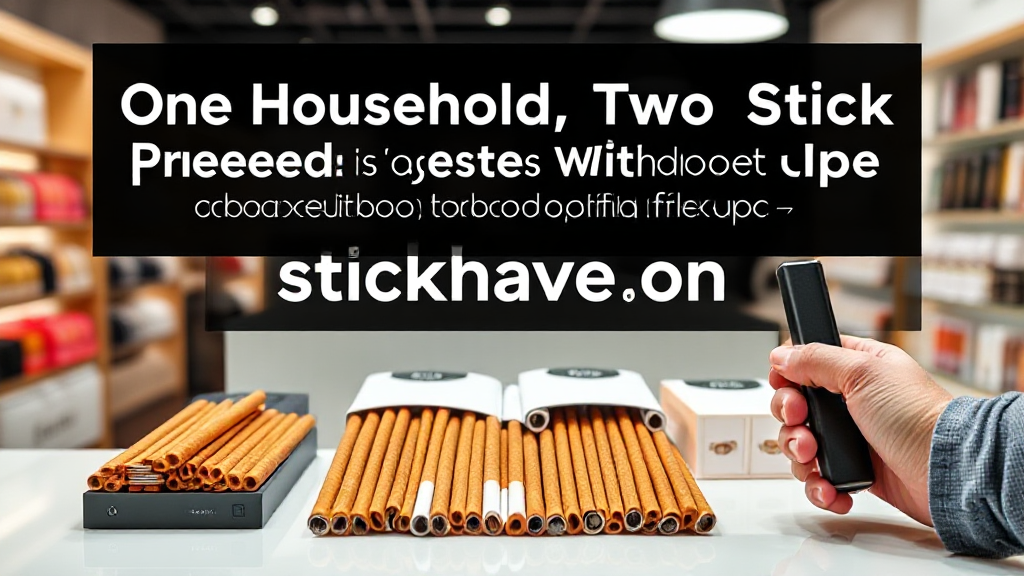
One Household, Two Stick Preferences: Ordering Together Without Mix-Ups
In our flat, the kitchen counter tells the story. On the left sits a neat stack of menthol TEREA sticks, and on the right, a slightly crumpled pack of FIIT tobacco-flavoured sticks. My partner and I both use heated tobacco devices, but we have completely different tastes. For a long time, that meant two separate online orders, two delivery windows, and a lot of confusion about whose box was whose. Eventually, we decided to order together — and it turned into a small project in household logistics.
This is the story of how we stopped mixing up our sticks. If you share a home with another IQOS or GLO user, the same three coordination steps can save you time, money, and the mild annoyance of discovering you have run out of your preferred flavour while your flatmate has three spare packs of theirs. Along the way, we found that a specialist retailer such as Stickhaven makes the process much easier, because one order can cover two very different preferences.
Step One: Map Each Person’s Sticks and Devices Before You Order
Before you place a combined order, you need a shared reference. In our case, the problem was simple: we both say “the blue pack” and mean two different products. My partner uses TEREA sticks with an IQOS ILUMA device, while I use FIIT sticks with a GLO Hil. If you hand either of us the wrong pack, the device simply will not work properly, and the flavour is wrong anyway.
So we made a household list. It has three columns: person, device, and stick brand. My partner’s row says IQOS ILUMA Prime with TEREA. My row says GLO Hil with FIIT. We also added a note about strength and flavour — menthol for one of us, classic tobacco for the other. That list lives on the fridge, and it takes about five minutes to create. It sounds overly organised, but it prevents the single most common mix-up: ordering the right brand for the wrong device.
It also helps to note which devices you own. Heated tobacco sticks are designed for specific device families. TEREA sticks are built for the IQOS ILUMA range, including ILUMA, ILUMA Prime, and ILUMA One. FIIT and DELIA sticks are commonly used with GLO devices. NEO and Kent sticks also appear in many households. Writing this down once means neither of you has to guess at checkout.
Once the list exists, the actual ordering becomes straightforward. You can browse your preferred brands side by side, compare pack sizes, and build a single basket that reflects two real preferences rather than one vague compromise.
Step Two: Build One Combined Order Without Losing Track of Quantities
The second coordination challenge is quantity. When two people order separately, each person guesses how much they will use. When you order together, you can see the whole picture — and that is where the savings and the sanity live.
We use a simple rule: each person estimates their usage for the coming month, then we round up slightly. If my partner goes through roughly eight packs a month and I go through six, we order fourteen packs plus a small buffer. The buffer matters because delivery times can vary, and running out on a Friday evening is nobody’s idea of a good weekend.
Here is where a retailer like Stickhaven earns its place in the routine. Because the store specialises in heated tobacco sticks for both IQOS and GLO, we can combine TEREA, FIIT, DELIA, NEO, and Kent in one basket instead of splitting the order across two shops. The site also sells the devices themselves, including the ILUMA range and the GLO Hil, which is useful if one of you is upgrading or replacing a device at the same time.
We also label our packs when the delivery arrives. A small sticker on each carton with an initial is enough. It sounds trivial, but it stops the classic household scene where one person opens a pack, realises it is the wrong flavour, and quietly puts it back hoping nobody noticed.
For context, here is how a combined household order tends to compare with the alternatives. The table below reflects our own experience and general market patterns, not a formal price survey.
| Option | Price | Pros | Cons |
|---|---|---|---|
| Combined order from a specialist heated tobacco retailer | Mid-range, with savings from one delivery fee | One basket for two preferences, fast delivery, original sticks, devices available in the same store | Requires a shared list and a little planning before checkout |
| Two separate orders from the same retailer | Higher, because delivery costs are paid twice | Each person controls their own basket and timing | Two delivery windows, more packaging, more admin |
| Buying from local convenience shops | Often higher per pack | Immediate availability, no waiting | Limited brand and flavour range, frequent stock gaps |
| Mixed sourcing across several online stores | Variable, with multiple delivery fees | Can fill gaps when one store is out of stock | Inconsistent authenticity, more tracking, more confusion |
In practice, the combined order wins for us because it keeps the household stocked while reducing the number of deliveries. The trade-off is a few minutes of planning, which is a fair exchange.
Step Three: Set Up a Reorder Rhythm That Both People Can Trust
The final piece is timing. Two people running out at different moments creates chaos. Two people running out at the same moment creates a small emergency. The fix is a shared reorder rhythm, and it does not need to be complicated.
We check our stock on the first weekend of each month. If either person is down to their last two packs, we place a combined order. This keeps the household from drifting into a situation where one person is fine and the other is scraping the bottom of a drawer. Because delivery from a specialist store is typically fast, we do not need to hoard months of supply — just enough to cover the gap between ordering and arrival.
We also keep a note of what we actually used, not what we thought we would use. After three months, the pattern became obvious: my partner consistently used more than estimated, and I consistently used less. Adjusting the next order took one minute and saved us from overbuying.
If you are the more organised person in your household, resist the urge to manage everything alone. Share the list, share the reorder reminder, and let the other person confirm their own preferences. The whole point of ordering together is that neither person ends up with a cupboard full of the wrong sticks.
One more practical note: if you are both considering a device upgrade, ordering devices and sticks in the same basket makes sense. The ILUMA, ILUMA Prime, and ILUMA One cover different needs and budgets, while the GLO Hil suits those who prefer that ecosystem. Matching the device to the stick brand at the point of order is far easier than discovering the mismatch later.
Frequently Asked Questions
Can two people with different devices order sticks in one basket?
Yes. A specialist retailer that stocks both IQOS-compatible and GLO-compatible sticks can combine TEREA, FIIT, DELIA, NEO, and Kent in a single order. The key is to keep each person’s device and brand noted so the right sticks go to the right person when the delivery arrives.
How do we avoid ordering the wrong sticks for the wrong device?
Write down each person’s device model and the stick brand designed for it. TEREA sticks are intended for the IQOS ILUMA family, while FIIT and DELIA are commonly used with GLO devices. Check that list before confirming the basket, and label the packs when they arrive.
Is a combined order actually cheaper than ordering separately?
Usually, yes — mainly because you pay one delivery fee instead of two. The per-pack price stays the same, but the total household cost drops, and you avoid duplicate packaging and duplicate delivery windows. The saving is modest but consistent over a year.
What if one person runs out before the other?
Set a shared threshold, such as two remaining packs for either person. When anyone hits that threshold, place the combined order. This keeps both people stocked without forcing anyone to buy emergency packs at a higher local price.
Do we need to buy devices at the same time as sticks?
Not necessarily, but it can be convenient. If one person is upgrading to an ILUMA model or a GLO Hil, adding the device to the same order as the household’s sticks reduces the number of deliveries and keeps everything arriving together.
Ordering together is less about saving a few pounds and more about ending the small daily friction of mixed-up packs. Once the list exists and the rhythm is set, the household runs itself — and both people get the sticks they actually want.